What If the Carbon Label on Your Product Was Doing More Commercial Work Than Your Marketing?
Most brands treat carbon labelling as a compliance box to tick. The ones paying attention are using it as a sales asset, a procurement advantage, and a reason for customers to trust them over a cheaper competitor.
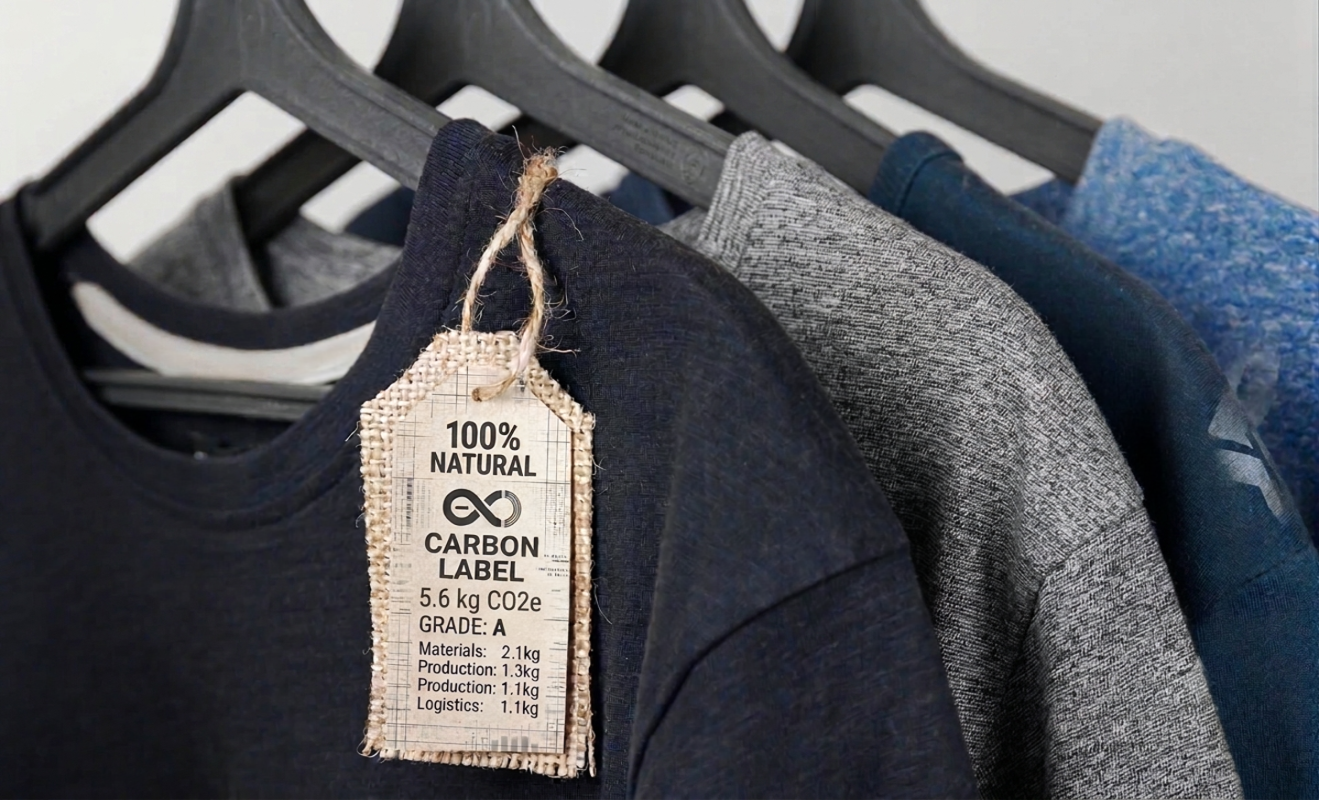
Most sustainability teams frame carbon labelling as a cost: a compliance obligation, a reporting exercise, something to get done and filed. That framing is understandable. It also leaves real commercial value on the table.
A verified carbon footprint is not just a disclosure. For the right audience, it is a purchase trigger, a price justification, a procurement qualifier and a trust signal. Businesses that see this treat their carbon label the way a strong brand treats its best creative: as something that does commercial work.
Here is what the research suggests, and why the framing needs to change.
Consumers Associate the Label with Quality
Marketing folklore says sustainability appeals only to a narrow group of environmentally minded shoppers. The research increasingly points the other way. A 2025 study in Scientific Reports found that awareness of eco-labels is linked to higher perceived product quality, and through that to a greater willingness to pay a premium. [1]
That matters because it means the label is communicating more than ethics. It signals care, rigour and transparency in production, and buyers read that as a proxy for quality overall.
Trust is what turns a label into a purchase decision
The usual criticism is that consumers say they care but do not change what they buy. But the explanation is mostly about trust, not indifference. Research indicates that carbon labels influence decisions most when they are third-party verified rather than self-declared. [2] A number printed on a pack without independent checks invites scepticism, and rightly so. The same number backed by an external audit is a different proposition.
Where carbon labels have been implemented well in food and retail settings, studies report shifts toward lower-emission options. [3] Just Salad, the U.S. chain that labelled its menu, reported sales of its lowest-emission items rising by nearly 10% after launch. [4] That is an encouraging signal, though it came alongside a curated menu and launch pricing, so it is not a controlled result.
The lesson is not that labels automatically shift behaviour. It is that credible labels do, and credibility is where most companies cut corners.
In B2B, the label is becoming a qualifier
For consumer-facing brands, a carbon label is still a differentiator. For businesses selling to other businesses, it is becoming something even more fundamental: a qualifier for whether you even make it onto the shortlist.
Procurement teams face their own reporting obligations. They need supplier emissions data for Scope 3 calculations under frameworks such as the GHG Protocol and CSRD. If you cannot provide product-level carbon data, you create a problem for your buyer, and buyers tend to remove friction by choosing a supplier who can. [5]
The Carbon Trust, which runs one of the best-established product footprint labelling schemes, positions the label as supporting both consumer choice and business procurement. [6] Carbon transparency is no longer only a consumer story. It is a supply chain story, and the brands that understand that are positioning themselves as the easier, lower-risk choice for procurement.
It protects your claims from legal exposure
This angle gets less attention and is now urgent. Since 27 September 2026, the EU's Empowering Consumers for the Green Transition Directive has applied across member states. It bans unsubstantiated generic environmental claims and carbon-neutral claims built on offsetting. [7] In the UK, the DMCC Act is tightening the rules on misleading green claims in a similar direction.
Brands with a credible carbon labelling programme are not just ahead on compliance. They hold a verified data foundation that makes their sustainability claims defensible. Brands relying on broad pledges and purchased offsets carry exposure they may not yet appreciate.
The commercial value of being on the right side of that line is hard to quantify exactly, but the cost of being on the wrong side is very concrete.
What This Looks Like in Practice
Measure the full lifecycle, not just the easy parts. A label built on a partial scope will not survive scrutiny from buyers, regulators or informed consumers. The credibility of the number is the whole asset.
Get it independently verified. Third-party verification is what turns a number on a pack into a trust signal.
Use it across the business. One verified footprint feeds procurement conversations, investor reporting, ESG scores and marketing claims at once.
Be consistent. One labelled product does not build a narrative. Labelling across a range builds a reputation for transparency that drives preference over time.
The brands seeing real returns are not treating labelling as a minimum compliance exercise. They measured properly, verified the result, and put it to work at every touchpoint where it creates value.
Done properly, a carbon label is one of the few marketing assets a competitor cannot copy with a bigger design budget. The number is the number, and if yours is credible and visible, that is a position worth owning.
Bibliography
- [1] Nature / Scientific Reports. (2025, January). Willingness to pay a premium for eco-label products in China: a mediation model based on quality value. https://www.nature.com/articles/s41598-025-86202-9
- [2] Cambridge University Press. Edenbrandt, A.K. et al. (2025). The future of carbon labeling: Factors to consider. Agricultural and Resource Economics Review. https://www.cambridge.org/core/journals/agricultural-and-resource-economics-review/article/future-of-carbon-labeling-factors-to-consider/FDBC62244F2ACA29A7602886085B4A91
- [3] ScienceDirect. (2025, February). Impact of different carbon labels on consumer inference. Journal of Cleaner Production. https://www.sciencedirect.com/science/article/pii/S0959652625003701
- [4] FoodPrint. (2025, February). Can climate-friendly food labels transform eaters into environmentalists? https://foodprint.org/blog/climate-friendly-food/
- [5] Normative. (2024). Carbon reporting legislation: an overview. https://normative.io/insight/carbon-reporting-legislation/
- [6] Carbon Trust. (2025). Product carbon footprint labelling. https://www.carbontrust.com/what-we-do/product-carbon-footprint-labelling
- [7] Arbor. (2025). What is the EU's ECGT Directive? A Business Guide for 2026. https://www.arbor.eco/blog/eu-ecgt-empowering-consumers-for-the-green-transition-directive
Ready to make impact visible?
Join brands turning sustainability data into a trusted consumer signal and a measurable business asset.
Or reach us at hello@zenero.world