Full Guide to the French Eco-Score 2026: Key Updates for Fashion Brands
Since 1 October 2026, any third party can publish a brand's score without its consent. This guide covers what changed, which products are in scope, the data required, and how to declare your own scores.
Legal status: In force.
Latest update: Third-party declarations have been open since 1 October 2026. Brands with an account on the official portal can register their product barcodes (GTINs) and are emailed each time a third party declares one of their products.
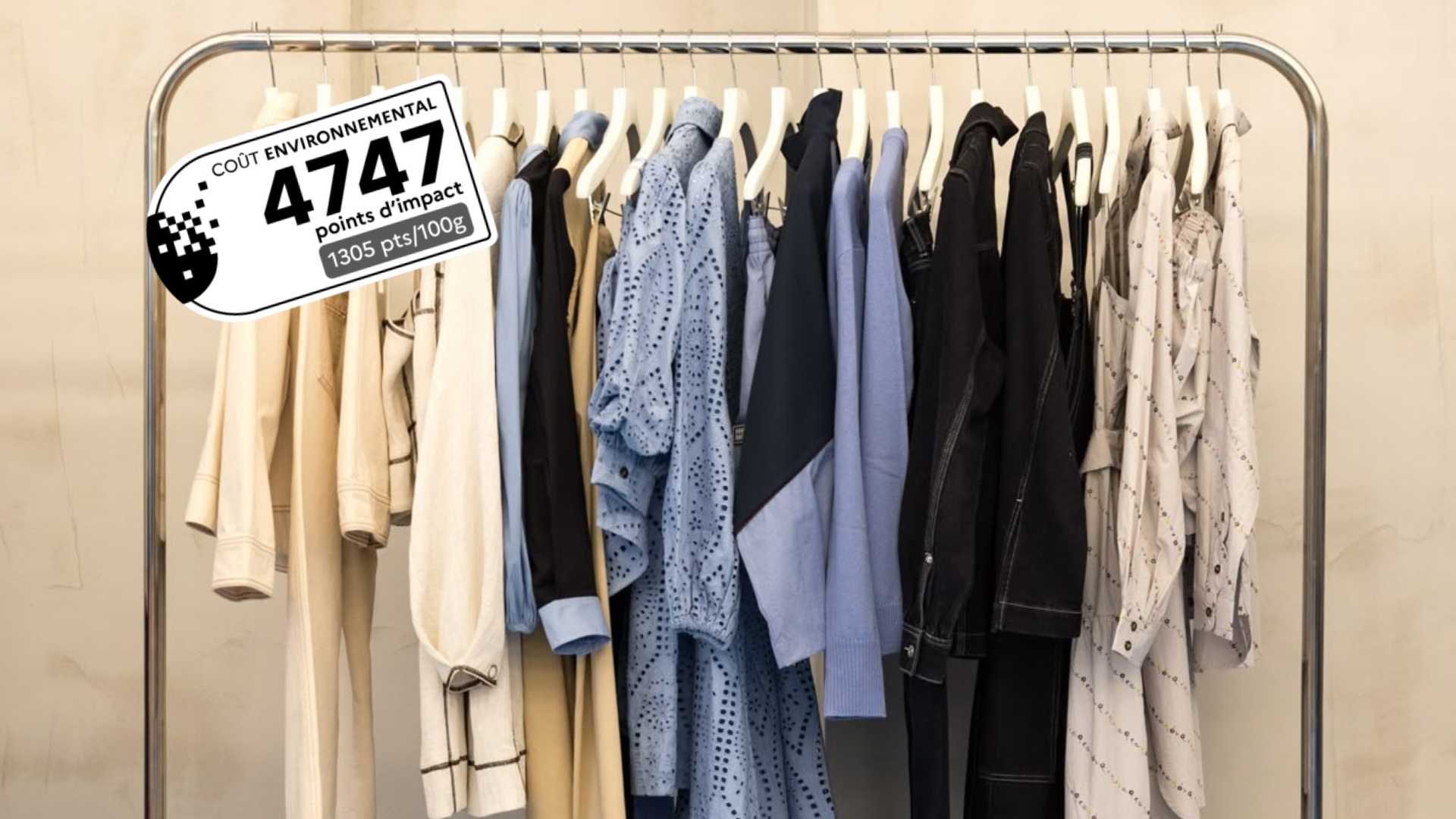
France's Environmental Cost (coût environnemental), widely called the French Eco-Score, rates clothing sold in France in impact points. Since 1 October 2026, any third party can publish a brand's score without its consent. This guide covers what changed, which products are in scope, the data required, and how to declare your own scores.
French Eco-Score at a glance
| Item | Detail |
|---|---|
| Official name | Environmental Cost (coût environnemental), part of France's textile environmental labelling scheme |
| Legal basis | 2021 Climate and Resilience Law; Decree No. 2025-957 of 6 September 2025 |
| Applies to | Producers, importers, and distributors placing in-scope clothing on the French market, wherever they are based |
| Is it mandatory? | Voluntary, unless you display another environmental score, in which case the Environmental Cost is required too |
| Voluntary declarations opened | 1 October 2025 |
| Third-party declarations opened | 1 October 2026 |
| Calculation method | Ecobalyse, the official French government calculator (life cycle assessments using 16 indicators) |
| Where scores are declared | The official environmental labelling portal, by CSV, API, or manual entry |
What changed on 1 October 2026
The decree gave brands two temporary protections. Both expired on 1 October 2026.
Third-party declarations are open. Until that date, an outsider could publish a product's score only with the brand's agreement or after the brand had published its own. Now any individual or organization, including retailers, comparison platforms, NGOs, journalists, and citizens, can declare the score of an in-scope product using the official method and the data available to them.
Other environmental scores trigger the Environmental Cost. If you communicate any other environmental score on a textile product, such as a carbon footprint on a product page or hang-tag, you must also display the official Environmental Cost. The two must be consistent. Before 1 October 2026, this applied only if you had already published an Environmental Cost.
Brands that display no environmental score are still not required to show the Environmental Cost.
What a default score looks like
A third party can see public data: the fibre composition on the label and, for larger brands, where weaving, dyeing, and assembly take place. For everything else, Ecobalyse applies conservative defaults:
Range size: 100,000 references on sale at once, which signals fast fashion and lowers the durability coefficient.
Repair: a large company with no repair service.
Spinning origin: India as the reference country when the real origin is unknown.
Default-based scores are usually worse (higher) than real ones. The official portal labels each declaration with a confidence index: Strong for the brand or a provider it has delegated, Average for a third-party company, and Weak for a citizen. Weak scores are still public. When several third parties score the same product, the portal shows their average, weighted by confidence.
When a brand declares its own score, it replaces any third-party score on the portal, and third parties then have up to one month to update their own communication.
Which clothing is in scope
The scheme covers new or remanufactured clothing made of at least 80 percent textile fibres by weight, in 11 categories.
Included: boxers and briefs, underpants, socks, shirts, jeans, skirts and dresses, swimwear, coats and jackets, pants and shorts, sweaters, and T-shirts and polos.
Excluded: second-hand items, shoes and leather goods, household linen, single-use clothing, products with electronic components, personal protective equipment, professional workwear, and products where more than 20 percent of the mass is made of materials Ecobalyse does not model.
Not yet modelled, but may be added: bras, padded down jackets, 100 percent silk shirts, and accessories such as scarves and caps.
How the Environmental Cost is calculated
Ecobalyse models a garment from raw materials through spinning, fabric formation, dyeing and finishing, assembly, transport, use, and end of life. It scores 16 environmental indicators, then differs from the EU's PEF method in three ways:
Weighting: climate change and freshwater ecotoxicity each carry 21.06% of the total. The two human toxicity indicators carry zero.
Durability coefficient: total impact is divided by a factor between 0.67 and 1.45. Half reflects range breadth and half reflects repair incentives, so a narrower range with a real repair offer scores better.
Added points: microfibre release, for all fibre types, and exports of used garments outside the EU.
Scores are calculated per colourway, using one representative size for the whole size run.
What data you need
Mandatory (six data points): product category, mass of the finished product, material composition, and the country of fabric formation, of finishing, and of assembly. Only raw material origin and spinning can be marked unknown.
Optional, and these improve (lower) your score: number of products in the segment, reference price, company size and repair service, raw material origin, spinning origin, printed surface, washing process, air-transport share, and accessories. If you leave them blank, defaults apply. If you hold real values, you are expected to use them.
Most mandatory data sits with your manufacturers: where fabric is formed, finished, and assembled. Collect it from suppliers per colourway before you start.
Zenero helps fashion brands prepare this product data for the French Eco-Score, and reuse it across carbon labels, LCA reports, and Digital Product Passports.
How to protect your brand: five steps
1. Create an account on the official portal and register your GTINs. You get an email alert whenever a third party declares one of your products. You can do this before you are ready to calculate.
2. Audit your product data. Check the six mandatory fields for every in-scope colourway, then collect the optional data.
3. Calculate with the official method. Use the Ecobalyse calculator, its API or open-source code, or software that follows the official rules.
4. Declare on the portal. Submit by CSV, API, or manual entry, yourself or through a delegated provider.
5. Decide where to display it. Declared scores are public on the portal. You do not have to show them on your own channels, unless you display another environmental score.
You can update a declared score at most once every three months. If the methodology changes, you have 12 months to revise your scores. Products already labelled do not need relabelling.
How to display the Environmental Cost
- Use the heading "Environmental Cost" ("Coût environnemental" in France).
- Show total impact points with the official pictogram, plus the score recalculated per 100 g of product.
- Online, link to the full data record on the official portal.
- Do not alter the design. You can only scale it proportionally.
- On a product page or shelf label, it must be legible similarly to the price. On hang-tags, it must stay clearly legible. In any medium, it must be at least as prominent as any other environmental score you show for that product.
Frequently asked questions
Is the French Eco-Score mandatory?
No. It is voluntary, unless you display another environmental score on an in-scope product. Then you must display the Environmental Cost as well.
Does it apply to UK and other non-French brands?
Yes. It applies to any company placing in-scope clothing on the French market, wherever it is based. The decree sets no size threshold.
Can a third party publish my score without my consent?
Yes, since 1 October 2026, if you have not declared your own.
How do I know if someone has declared my products?
Create an account on the official portal and register your GTINs. The portal emails you when a product is declared.
Can I correct a score after declaring it?
Yes, at most once every three months. A declaration cannot be deleted, but it can be updated with better data.
What if I already show a carbon footprint?
Since 1 October 2026, the Environmental Cost must appear alongside it on every medium where the carbon figure appears, including physical tags.
Bibliography
- [1] Décret n° 2025-957 du 6 septembre 2025 relatif aux modalités de calcul et de communication du coût environnemental des produits textiles. Légifrance. https://www.legifrance.gouv.fr/jorf/id/JORFTEXT000052212871
- [2] Ministry of Ecological Transition. (2025, 1 October). Official methodology notice for the environmental cost of clothing. https://affichage-environnemental.ecobalyse.beta.gouv.fr/notice-reglementaire-english.pdf
- [3] French government. Environmental cost declaration portal. https://affichage-environnemental.ecobalyse.beta.gouv.fr/
- [4] French government. Ecobalyse calculator. https://ecobalyse.beta.gouv.fr
- [5] Direction générale des Entreprises. (2025, 1 October). Affichage environnemental sur les vêtements : accompagner les entreprises du secteur dans leur transition écologique. https://www.entreprises.gouv.fr/la-dge/actualites/affichage-environnemental-sur-les-vetements-accompagner-les-entreprises-du
- [6] Ministère de la Transition écologique. Affichage environnemental des vêtements. https://www.ecologie.gouv.fr/politiques-publiques/affichage-environnemental-vetements
- [7] European Commission. TRIS notification 2025/0086/FR: Decree on the methods for calculating and communicating the environmental cost of textile products. https://technical-regulation-information-system.ec.europa.eu/en/notification/26666
Ready to make impact visible?
Join brands turning sustainability data into a trusted consumer signal and a measurable business asset.
Or reach us at hello@zenero.world