Why Carbon Labels Are the New Nutrition Labels
Why carbon labels are needed and becoming an important aspect of our day to day life.
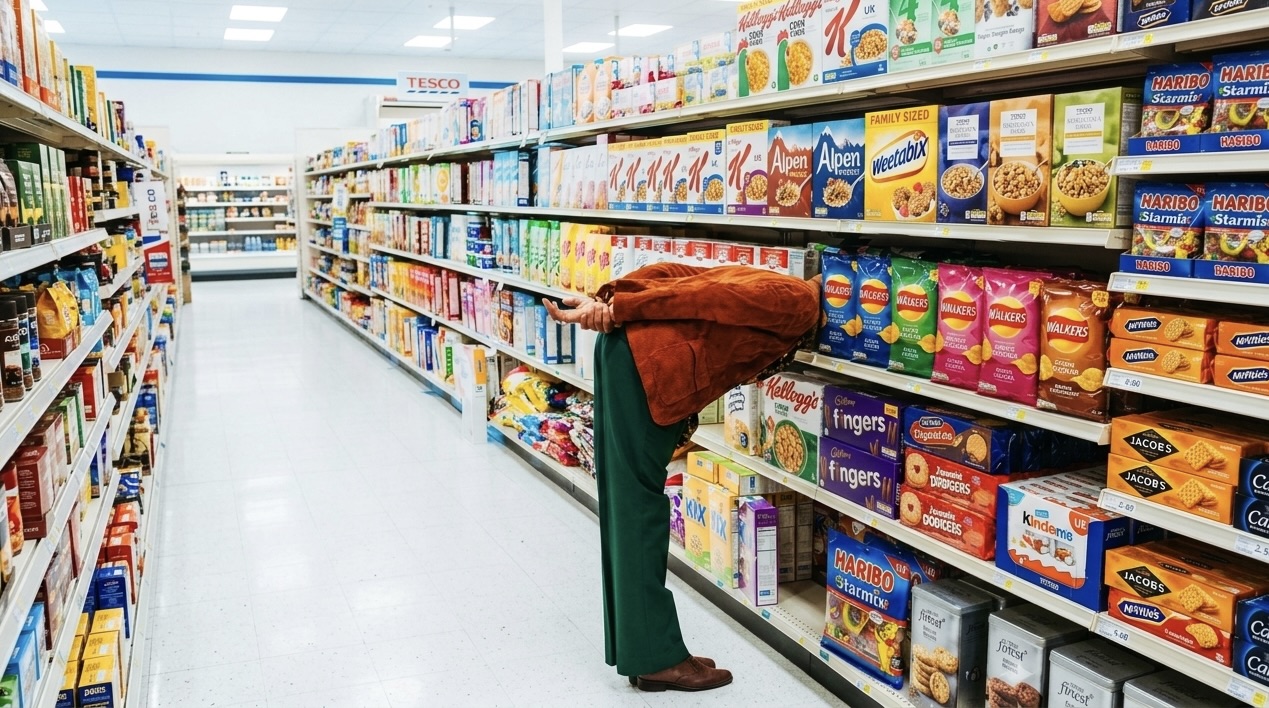
You don't eat a bag of chips without glancing at the back. Somewhere between the couch and the kitchen, you've been trained almost without realizing it to ask: what's actually in this? Now imagine you never could. Imagine calories were a trade secret. Imagine food companies could just say "pretty healthy, trust us" and that was enough. It sounds absurd. But that's exactly where we are with everything else we buy. That jacket. That phone case. That flat-pack bookshelf. Each one left a trail of emissions: coal burned, forests cleared, freight ships cutting through oceans before it ever landed in your hands. And right now, you have no way of knowing how much. You're consuming blind.
The label that changed eating
In 1990, the US made nutrition labels mandatory. It wasn't a popular move with the food industry. But something unexpected happened: people started caring. Not everyone, not immediately, but enough. Gradually, "low fat" stopped being a marketing slogan and started being a measurable fact. Companies reformulated products not because they wanted to, but because the number on the back made lying expensive. The label didn't lecture anyone. It didn't ban anything. It just made the invisible visible. And that was enough to shift a multi-billion dollar industry. Carbon labels are attempting the same quiet revolution for the planet.
The number behind the product
A carbon label tells you how much CO₂ was released to make something. Not just the factory part—everything. The raw materials, the manufacturing, the packaging, the shipping. The full story, distilled into a single number, expressed in kilograms of CO₂. It's not a moral judgment. It's just information. The same way a calorie count doesn't tell you whether to eat the cookie, it just tells you what the cookie costs. But here's the thing about information: it's contagious. Once people can compare, they do. Once companies know people are comparing, they compete. That's not idealism, that's how markets work.
Why now feels different
We've always known, abstractly, that consumption has consequences. But "abstractly" is doing a lot of heavy lifting there. Abstract concern doesn't change behavior. Numbers do. The timing matters too. Climate change has stopped being a future problem. The droughts, the floods, the summers that don't feel like summers anymore, these aren't projections. They're the news. People are looking for something to do that isn't just hoping. Carbon labels offer that. Not a sacrifice. Not a lifestyle overhaul. Just a better-informed version of the same choice you were already going to make.
The problem with "eco-friendly"
For years, brands have been allowed to say almost anything. "Sustainable." "Green." "Conscious." "Earth-friendly." These words have a specific effect: they make you feel better without giving you anything to check. This is called greenwashing, and it's everywhere. Carbon labels are its antidote because a label doesn't care about your marketing department. A number is a number. Either your product produces 2kg of CO₂ or it produces 18kg. The packaging doesn't get a vote. That accountability is uncomfortable for some companies. For others who've actually done the work, it's an opportunity. Finally, they can show what they've built instead of just saying it.
Every purchase is a vote but only if you know what you're voting for
The nutrition label didn't change diets overnight. But it gave people the power to choose differently and over time, industries changed with them. Carbon labels can do the same. The question isn't whether consumers care. Research consistently shows they do, especially when they can actually see the impact in front of them. The question is whether the information is trustworthy enough to act on.
That's where the science has to be airtight. At Zenero, we take product data through a standardized, automated process built on methodologies like the Greenhouse Gas Protocol and ISO 14067:2018—not because the acronyms sound impressive, but because when a number goes on a label, it has to mean something. It has to be the kind of number that holds up under scrutiny, not the kind that gets quietly revised after a journalist calls. Because the goal isn't a label. The goal is a label people can trust. And trust, once earned, is what turns information into action.
The future of shopping may not begin with buying less, but with finally knowing more.
Bibliography
- [1] International Food Information Council (IFIC). (2025). The Nutrition Facts Label: Its History, Purpose and Updates. https://ific.org/resources/articles/the-nutrition-facts-label-its-history-purpose-and-updates/
- [2] Wikipedia. (n.d.). Nutrition Labeling and Education Act of 1990. https://en.wikipedia.org/wiki/Nutrition_Labeling_and_Education_Act_of_1990
- [3] United Nations. (n.d.). Greenwashing – the deceptive tactics behind environmental claims. https://www.un.org/en/climatechange/science/climate-issues/greenwashing
- [4] Carlsson, F., Kataria, M., & Lampi, E. (2025). The future of carbon labeling – Factors to consider. Agricultural and Resource Economics Review. https://www.cambridge.org/core/journals/agricultural-and-resource-economics-review/article/future-of-carbon-labeling-factors-to-consider/FDBC62244F2ACA29A7602886085B4A91
- [5] Andersson, E., et al. (2023). Can carbon labels encourage green food choices? PMC / Frontiers in Psychology. https://pmc.ncbi.nlm.nih.gov/articles/PMC9912457/
- [6] GHG Protocol. (n.d.). Product Life Cycle Accounting and Reporting Standard. https://ghgprotocol.org/product-standard
- [7] International Organization for Standardization. (2018). ISO 14067:2018 – Greenhouse gases: Carbon footprint of products. https://www.iso.org/standard/71206.html
- [8] Carbon Trust. (2020). The evolution of product carbon footprinting. https://www.carbontrust.com/news-and-insights/insights/the-evolution-of-product-carbon-footprinting
- [9] Bain & Company, as reported by ESGToday. (2023). Consumers Willing to Pay 12% Premium for Sustainable Products: Bain Survey. https://www.esgtoday.com/consumers-willing-to-pay-12-premium-for-sustainable-products-bain-survey/
- [10] Bergquist, M., Nilsson, A., & Schultz, P. W. (2019). Experiencing a Severe Weather Event Increases Concern About Climate Change. Frontiers in Psychology. https://pmc.ncbi.nlm.nih.gov/articles/PMC6378300/
- [11] Golden, K. (2026). Decomposing Greenwashing: Effectiveness of United States Regulation of Environmental Marketing Claims in Consumer Products. Masters Thesis, Harvard University Division of Continuing Education. https://dash.harvard.edu/entities/publication/7fe2e0e4-1428-4a4f-a438-f84007558ff6
Ready to make impact visible?
Join brands turning sustainability data into a trusted consumer signal and a measurable business asset.
Or reach us at hello@zenero.world